
In any sand and gravel production line, the circular vibrating screen is arguably the core piece of equipment for the screening process. Its working condition directly determines the passing rate of product particle size and the overall smoothness of the entire line. But anyone who works with a vibrating screen must be aware of a constant dilemma: after some time of operation, the screen becomes blocked; accumulation begins, and finally, the line has to be stopped to send workers with crowbars and shovels to clean out the machine. This may happen more than once per day and throw everything into complete disorder.But what causes the constant blockage of a circular vibrating screen? What is the source of the problem? Is it an incorrect choice of machinery or improper operation? Most importantly, is there any possibility to resolve this issue permanently without having to stop the vibrating screen machine often? After numerous years of practice and field screening operations, this article provides you with four guaranteed ways to do that. If your production line is also suffering from clogging, these insights should help you find a way out.
A lot of people tend to consider a plugged vibrating screen to be no worse than poor screening efficiency, which can easily be solved by cleaning. Yet, anyone who had some hands-on experience in dealing with this problem realizes that clogging and accumulation lead to way more complications than reduced screening efficiency. The problem affects the production line in five major areas: screening efficiency, wear-and-tear of the equipment, further operations, safety, and expenses.
We shall begin with screening efficiency. If large particles block the screen mesh, the usable area becomes smaller and smaller. Moreover, the fine particles that were supposed to pass through freely are carried together with the oversize material due to plug in the screen, thus resulting in reduced yield of the final product. Furthermore, the accumulated material begins to compress due to constant friction. Instead of taking minutes to finish screening process, it can last from 10 to 30 minutes and reduce capacity twofold.
And what about damage to the equipment? A lot of maintenance personnel know that when they open the screen box of a circular vibrating screen, the screen decks are very warped and have actually separated from the tension plates. This is the result of the accumulation of material that exceeds the load capacity of the screen. On top of that, material distribution being uneven leads to the screen box vibrating unbalanced. The vibrating force needs to be distributed evenly but the presence of a material pile pulls it in a particular direction which leads to the spring becoming unevenly loaded and eventually breaks. In the worst-case scenario, cracks appear in the screen box made of steel plates. But not only the screen fails due to the excessive vibration: the vibrations lead to the vibrator unit operating under constant overload; its temperature quickly rises especially in hot weather, the current remains high, and the motor housing gets too hot to touch. Bearings of such a vibrator unit fail faster, too – while normally they could last a whole year, now they require replacement within three months.
It doesn’t end there, however: the material accumulated on the screen does not fall steadily. There are instances when it falls down at once, creating avalanches on the belt conveyor or even on the crusher underneath. It becomes overloaded immediately, moves misaligned, and starts consuming too much energy to operate. It trips because of an overload. Even if it passes the falling material into the crusher, it can cause the crushing chamber to fill with material in a matter of seconds. The motor stalls, the crusher stops.
It cannot be overlooked that safety problems can arise when a blocked screen outlet clears and large lumps, which were previously stuck in it, will be discharged from there with great force because of the vibrations, thus posing a danger for the workers operating near the equipment. If there is a buildup of materials only in one part of the screen box, the center of gravity can move to that side. This may make the equipment overturn. Combustible materials such as coal or wood can result in dust forming in the places where clogging occurs; this dust can become spontaneously inflammable after coming into contact with hot components.
The main effect of clogging the screen openings is production interruptions and additional costs. Clearing each blockage takes at least half an hour or more. An interruption in production of an hour on an assembly line with hourly output in the order of several hundred tons is equivalent to several hundreds of tons of losses. Screen equipment, springs, bearings, and motors need replacing much earlier than they should because of constant blockages. Costs for maintenance, workers, and losses due to interrupted production can amount to quite a lot. Screen box material clogging
 Screen box material clogging
In order to resolve any problem, it is important to determine its root cause. As the field experience and experiments show, when material which is crushed by jaw crushers, in most cases with sizes 100–200 mm, is fed directly into the circular vibrating screens, clogging occurs almost inevitably. In turn, there are two major causes of such phenomena:
1.The structural properties of the woven wire mesh
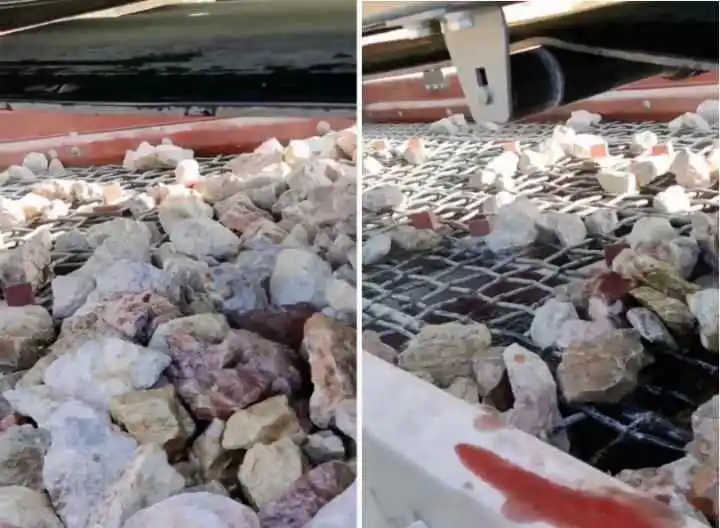
The openings in an ordinary woven wire mesh are made in a rectangular or square shape due to the interwoven wires. Such construction can cope with medium sized particles. However, when lumps of 100–200 mm are being placed directly on the surface of the screen, sharp corners of such lumps easily enter the openings. Due to the heaviness of lumps, together with the oscillations performed by the machine, lumps are wedged further and further and cannot go back freely. Consequently, having some part of openings closed, the following particles will collide with such "nails" and will be accumulated around them. Accumulated material will block the following material, causing rapid expansion of clogging zones. From blocking several openings to formation of clogged area may take only a couple of minutes.
2.Geometrical dimensions of big particles
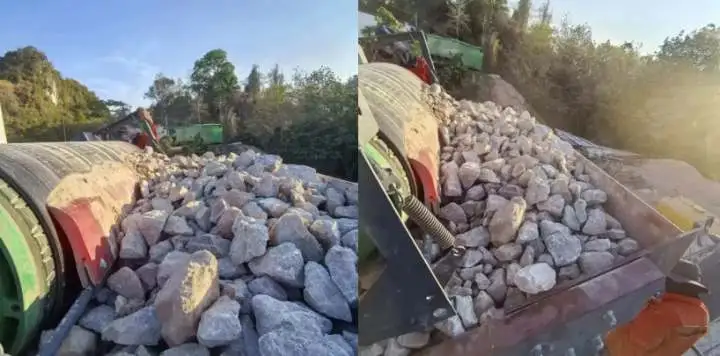
This can be easily seen from on-site photos. First of all, there usually is a great quantity of stone accumulated between the end of the discharge belt and the screen bed. In certain cases, the amount of stone exceeds the height of the side plates of the screen. As a result, the screen bed bends, the tension plates bend, and the vibration amplitudes of the two sides of the screen differ. After the screen box opening, it becomes clear that the screen itself is torn apart or even torn off from the tensioning groove. Thus, we once again face the same fact - the woven wire mesh is weak against big stones due to its inability to yield to them and poor flowability.
As evidenced by many years of screening calculations and field testing, MPCompany managed to identify four measures which can help resolve this problem. These methods have been tested many times on production lines with sand and gravel screening. When properly applied taking into account specific conditions of each facility, they can ensure efficient operation of the vibrating screen and prevent clogging from occurring.
1.You should consider increasing the amplitude of the circular vibrating sieve which will help increase the throwing height of material. Some plant managers may feel uneasy when hearing such advice as they believe that increasing amplitude is a sure way to harm equipment. In reality, there is no reason to be concerned about this issue as the amplitude of the vibrating screen can be regulated. As a result, when increasing amplitude within safe limits you will enhance vibration characteristics. The main idea behind this measure is as follows: the greater the amplitude, the farther material will fly during throwing. As a result, it will stay in the slots for shorter period of time making its clogging less likely to occur. What is more, small particles which got stuck during vibrations due to their weight and size, will easily fall out because of the increased throwing effect. However, one should pay attention to the fact that increasing amplitude should be performed considering existing conditions on site. Specifically, you should set an adequate amplitude value depending on size, density, and humidity of particles. Generally speaking, in case of processing 100-200 mm lumps, amplitude can be increased by 1-2 mm compared to normal values.
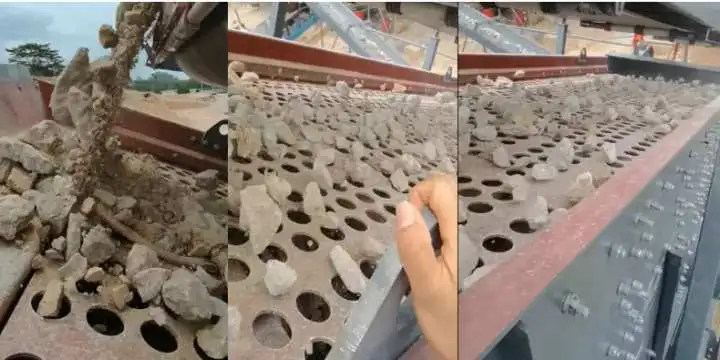
2.By far more effective approach consists of replacing the regular woven wire mesh screen with the screen panel having holes of circular shape. This design of the screen panel differs significantly from the traditional one in both its structure and operation. The surface of such panel is represented by the flat steel plate with rows of circular holes cut into it. Since there are no sharp edges on the round holes, the probability of particles being stuck inside them is much lower than when dealing with either squares or slots. The round holes cannot get the particle because of lack of corners; hence, even in case of oblique angle of impact, it will be easy for them to escape without becoming trapped inside. Moreover, due to being flat, the surface allows material to slip and rebound from it rather than get trapped within the recesses of the woven mesh. In many plants, it was noted that using this type of screen panels reduces the amount of time spent on cleaning by at least twice as much. If earlier the machine had to be stopped every day, now it is possible to run them for several days without performing any cleaning procedures. The only thing worth mentioning is that the ratio of opening areas in the case of flat plate is generally slightly lower than in the woven wire mesh.
3.Appropriately increase the installation angle of the vibrating sieve. Under regular conditions, the angle of the installation of the circular vibrating screen will fall within 15-25 degrees. By increasing the installation angle from 1 to 3 degrees without influencing the efficiency of screening, we will significantly raise the velocity at which the material slides down the surface of the deck. Due to this fact, the material will not have sufficient time to gather on the surface and cause jamming, while the productivity of the device will be increased. On the other hand, there is a limit. In case the installation angle is low, the material will move slowly and jam; while an angle that is too high will lead to the rapid removal of the material before the process of filtering and to the loss of small particles. This phenomenon is known as fines in oversize and lowers the quality of the product. Therefore, the optimal strategy would be gradual modification – for example, 0.5 and 1 degrees per try until the best results are obtained. Depending on moisture levels, the angle can be increased further.
4.The fourth method is less well-known, but equally important: there should be sufficient clearance between the belt conveyor and the feed box of the screen. More precisely, one needs to verify and improve the vertical and horizontal clearance between the discharge end of the belt conveyor and the input point of the vibration screen. Many designers of industrial lines, in an attempt to economize on the installation area, install the two units close to each other. In such a case, large pieces that drop from the belt conveyor have no room for spreading and they get compressed and collide or bounce around, resulting in a secondary accumulation. The problem can be solved without purchasing any additional equipment. It will be sufficient to make some adjustments in the placement of the belt conveyor or the screen according to the largest size of the piece. In general, it should be remembered that the vertical clearance needs to be at least 1.5 to 2 times larger than the largest piece size. Besides facilitating unloading, such clearance makes it more convenient to monitor and maintain equipment and eliminate possible bottlenecks.
In case all above-mentioned steps are carried out simultaneously, the difference in the work of the circular vibrating screen will be evident by itself. Multiple video records from optimized plants clearly show there is virtually no accumulation of blocks on openings – the materials flow evenly and constantly, quite differently from the local accumulation and chaotic movement observed previously. Now the production line operates smoothly from morning till late night hours, never requiring a break in order to perform maintenance activities for the screen.To be more specific, the optimized screening technology brings about the following benefits:  Clog-free optimized screen holes
1.The screen deck operates without any clogging, materials move uniformly, screening effectiveness significantly increases, and the yield rate of the final product does not vary much but reaches its optimum value.
2.The operation becomes smooth – the screen deck vibrates regularly, the lifespan of springs, vibrators, and engines considerably increases and the chances of overload and damage reduce considerably.
3.Downstream process stages experience no avalanches anymore – belt conveyors and crushers operate steadily and the capability of continuous production grows drastically.
4.Safety problems such as flying materials, machine overturning, and dust explosions practically cease to exist, ensuring greater coMPort and security for plant operators.
5.Shutdown frequency decreases drastically and replacement rates of various screen units and wearing elements become smaller, thus lowering production costs.
Clogging and material accumulation when screening materials containing larger particles has been a headache for many sand, gravel and mining industries for a long time now. A conventional circular vibrating screen with regular woven wire mesh tends to clog, overload and even cause potential accidents when working with 100-200 mm large particles. But this issue is definitely curable – there are specific reasons behind it and ways to fix the problem.With systematic analysis of the main reasons and implementation of four specific methods – an appropriate increase in amplitude, use of anti-clogging screens, appropriate increase of inclination angle and enough clearance space between the belt conveyor and vibrating screen – you will address this issue from various aspects such as material projection height, flowability, sliding speed and discharge space. Thus, this will provide a solution that tackles the issue at the root level. Each individual production line has different material properties and operation processes, therefore a custom-made solution should be chosen to ensure maximum efficiency. Should your sand and gravel production line suffer from frequent clogging problems, you are welcome to get in touch with our sales and service team for more information on technical parameters and real cases. Only after solving this issue, the performance of vibrating screen can be maximized.






Long Press to Scan QR Code
Scan QR Code