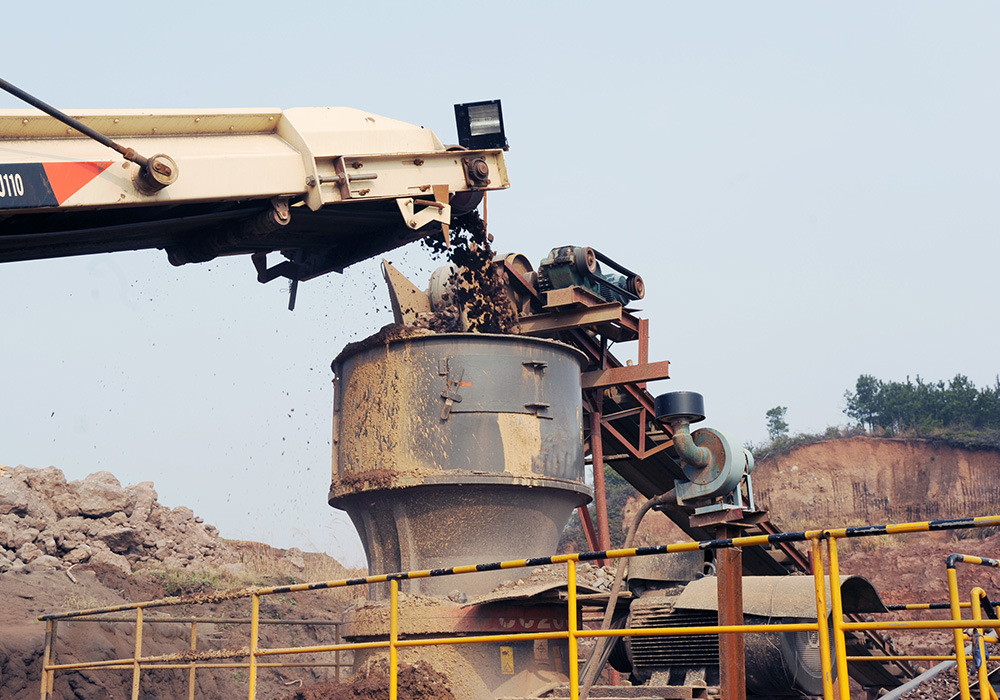
Limestone, Bluestone, DolomiteLimestone, bluestone, dolomite and other medium-hard rocks with a compressive strength of 100–150 MPa represent the most widely used raw materials for infrastructure aggregates across the globe. Featuring moderate hardness and excellent crushability, these materials pair perfectly with impact crushing technology. When compared to conventional crushing methods, impact crushers deliver uniformly graded, cubical aggregates while consuming less operational energy.MP tailors dedicated crushing solutions for medium-hard rock to match the unique operational models and field conditions of overseas engineering contractors, concrete manufacturers and artificial sand producers. Every solution is engineered around real overseas working scenarios, resolving core challenges throughout the entire project lifecycle ,including delayed commissioning, high operational costs, inconsistent product quality, complicated maintenance and strict environmental compliance. All equipment configurations and technical indicators fully comply with international standards, ensuring stable and reliable deployment in global markets.
1.Two-Stage Crushing Plant for Road & Stabilized Base Aggregates
This two-stage crushing solution is specially developed for overseas contractors undertaking highway, airport runway and municipal substructure projects. These clients boast professional on-site construction capabilities but rarely have hands-on experience operating large-scale crushing lines. Their projects are commonly defined by tight deadlines, strict penalty clauses, fixed budgets and continuous aggregate supply demands. Meanwhile, their processing systems must accommodate various local medium-hard materials, including limestone, bluestone and weathered rock.Three core challenges consistently trouble these overseas producers: unpredictable commissioning timelines, uncontrollable production costs and uncertain product compliance. Overseas infrastructure projects enforce extremely rigorous schedule requirements. Complex installation procedures, insufficient standardized guidance and inexperienced local workers often delay full production, triggering immediate aggregate shortages on construction sites. Additionally, budget-conscious clients closely monitor unit power consumption, labor expenses and overall investment, fearing redundant equipment layouts, capital waste and extended payback cycles. Furthermore, aggregate specifications vary drastically by region, with widely adopted standards such as ASTM D2940, BS EN 13285 and AASHTO M147, leaving clients unable to pre-verify flakiness index, liquid limit and plastic limit compliance.
These common operational issues translate directly into severe financial and reputational risks for overseas projects. Schedule delays incur heavy contractual penalties and may even lead to project termination. Improper equipment configuration and excessive energy consumption continuously erode profit margins and reduce overall return on investment. Non-compliant aggregates cannot be used for construction and require full disposal, resulting in raw material and energy waste. This chain of problems further causes construction suspension, acceptance delays and repeated rework, seriously hindering project progress and damaging clients’ local credibility.
To eliminate all pain points and potential risks in subbase aggregate production, MP delivers a customized two-stage crushing solution optimized for fast overseas deployment, low-cost operation and full international compliance. Adopting a streamlined jaw and impact crushing combination, our solution avoids redundant equipment configuration by matching layout scale to actual output demands and material characteristics, effectively controlling overall investment. The plant maintains a stable power consumption of 3.5–4.5 kWh per ton, drastically cutting daily operational costs. Our process steadily confines the aggregate flakiness index within 15%. We adjust crusher discharge openings and screen specifications according to local standards and provide complete particle size test reports to guarantee full compliance with global subbase requirements.To ensure on-time project delivery, we supply complete English installation manuals and high-definition instructional videos to lower local training barriers. Optional on-site engineering services cover full equipment installation, professional commissioning and hands-on operational training, enabling rapid plant startup and uninterrupted material supply.The two-stage crushing process is perfectly suited for medium-hard subbase materials.
With moderate hardness and low crushing resistance, these rocks fully adapt to impact crushing principles without the need for complex three-stage shaping processes. Featuring a simple mechanical structure, minimal maintenance needs and low manual reliance, this system precisely fits overseas clients’ limited plant operation experience, tight schedules and budget constraints. It remains the most cost-effective and rapidly deployable solution for short-term and mobile infrastructure projects.The full production line consists of PEV/PEW series jaw crushers for primary crushing, PFC T-series impact crushers for secondary shaping, and YK circular vibrating screens for particle grading. Supporting single-layer or double-layer screen configurations, the plant operates in both open-circuit and closed-circuit modes, with a capacity ranging from 150 t/h to 800 t/h. The impact crusher’s minimum discharge opening is adjustable between 20 mm and 30 mm, delivering stable finished particle sizes of 20–40 mm with a maximum particle size below 40 mm. For projects requiring full gradation under 31.5 mm, a closed-circuit screening system returns oversize materials for secondary crushing.Notably, the final particle size of impact crusher products is primarily determined by rotor speed and the gap between blow bars and impact plates. The discharge opening mainly controls material throughput and recirculation volume, with limited influence on finished particle size. This mature solution enables low capital investment, minimal energy consumption, fast commissioning and consistent quality compliance. Its finished aggregates fully meet JTG/T F20 and ASTM D2940 standards, helping clients completely avoid schedule penalties, cost overruns and project acceptance failures.
2. Three-Stage Crushing Solution for High-Grade Concrete Aggregates
This three-stage premium aggregate crushing solution serves professional aggregate suppliers supporting overseas commercial concrete batching plants, precast component factories, high-speed railways and bridge-tunnel projects. These professional operators maintain dedicated technical teams, pursue long-term continuous large-scale production, and enforce strict standards for aggregate particle shape and gradation stability. They prioritize equipment wear resistance, spare parts availability, plant automation levels and after-sales response efficiency, aiming to consistently produce high-standard aggregates while minimizing long-term maintenance and labor costs.High-grade concrete aggregate production involves refined, high-stakes challenges that directly determine product qualification rates and engineering safety. First, conventional crushing processes produce aggregates with sharp edges and excessive flakiness, failing to meet strict international criteria including ASTM C33 and EN 12620, which mandate a flakiness index below 10%. Second, medium-hard materials cause significant abrasion to blow bars, liner plates and other wear parts. Long overseas supply chains and prolonged procurement cycles delay urgent replacement, easily triggering unplanned downtime and production losses. Third, traditional plants require frequent manual adjustment of feeding and discharge parameters. High overseas labor costs increase operational overhead, while human errors cause unstable aggregate quality and inconsistent gradation.These operational defects severely undermine clients’ profitability and engineering safety. Aggregates with excessive flakiness are rejected by concrete manufacturers, causing massive material waste and inventory backlogs. Poorly shaped aggregates reduce concrete fluidity and filling density, leading to pumping blockages, structural voids and surface defects during construction. These flaws weaken concrete structural strength and create critical engineering hazards. Frequent downtime disrupts long-term production schedules, resulting in output shortages, delayed orders and customer attrition. Persistent quality instability also prevents compliance with standardized production requirements for high-end infrastructure, greatly weakening market competitiveness.
To satisfy the stringent production standards of high-grade concrete aggregates, MP develops a professional three-stage crushing framework integrating primary crushing, secondary crushing and optional VSI shaping, comprehensively upgrading product quality, overseas maintenance efficiency and intelligent production performance. For conventional commercial concrete production, the combination of jaw crusher, impact crusher and closed-circuit screening stabilizes the flakiness index between 10% and 15%. For high-standard projects such as high-grade concrete and railway infrastructure, an additional VSI vertical shaft impact crusher provides precision shaping treatment. This reduces the flakiness index to below 8% and eliminates internal residual stress and sharp edges in crushed materials, fundamentally removing hidden construction risks and ensuring overall structural stability and strength.To resolve overseas spare parts supply bottlenecks, MP recommends clients stock essential wear parts ,including blow bars, liner plates and screen meshes ,during equipment delivery. We provide complete wear part catalogs and replacement cycle guidelines to support routine preventive maintenance. For sudden equipment failures, we support expedited spare parts delivery and full remote replacement guidance to minimize plant downtime. In terms of intelligent production, the full line is equipped with a PLC control system that real-time monitors main unit current, material levels and equipment temperature, automatically adjusting feeding volume and discharge opening clearance. Equipped with hydraulic quick-adjust mechanisms and expandable DCS centralized control systems, the plant minimizes manual intervention and enables unmanned, standardized production tailored to high overseas labor costs.
Three-stage processing is indispensable for high-grade concrete aggregates, as two-stage crushing only meets basic particle shape requirements and cannot eliminate material residual stress or deliver premium shaping effects. The graded crushing and optional shaping system achieves adjustable quality grades, covering both ordinary commercial concrete mass production and ultra-high-standard infrastructure projects. The production line adopts PEV/PEW series jaw crushers for primary crushing, PFC impact crushers or CC/MHP cone crushers for secondary crushing, and VSI vertical shaft impactors for fine crushing and precision shaping in high-grade working conditions. Matched with double-layer or triple-layer YK circular vibrating screens for closed-circuit screening, the plant covers a capacity range of 100–500 t/h. Configurations without VSI equipment meet ordinary commercial concrete standards, while VSI-equipped lines fully comply with ASTM C33 and EN 12620 high-grade concrete specifications.The VSI crusher features high material throughput, fewer wearable components and simplified replacement procedures, with switchable dual crushing modes. Its middle-opening structure simplifies internal inspection and daily maintenance, while hydraulically liftable racks greatly reduce overhaul difficulty.
With low overall wear consumption, it applies widely to rock shaping, artificial sand making, tailings recycling and construction waste reuse. A cone crusher-based closed-circuit three-stage process stabilizes the flakiness index below 10% for conventional materials, while VSI equipment specializes in eliminating residual stress and optimizing particle geometry to guarantee the superior construction performance and structural safety of high-grade concrete.
3.Dry & Wet Dual-Process Plant for Premium Manufactured Sand Production
Against the backdrop of global natural sand resource depletion and tightening environmental bans on natural sand extraction, 0–5 mm manufactured sand has become the core raw material for dry-mix mortar, ready-mixed concrete and asphalt pavement projects. This customized sand-making solution targets professional overseas sand producers and building material manufacturers with strict requirements for fineness modulus, stone powder content, gradation uniformity, plant stability and eco-friendly production.Overseas manufactured sand production faces three persistent industry pain points. First, traditional equipment fails to achieve precise control over fineness modulus and stone powder content, resulting in unstable finished sand quality. Second, single-process production cannot adapt to diverse global regional conditions: wet processing consumes large volumes of water with high wastewater treatment costs, while improperly managed dry processing easily causes excessive dust emissions and environmental penalties. Third, low sand yield rates and massive circulating materials lead to insufficient actual output, unmet design capacity and severe energy waste.These problems trigger direct economic losses and compliance risks for producers. Unstable fineness modulus and stone powder content undermine the workability, compactness and structural strength of mortar and concrete, resulting in unqualified building materials and damaging corporate reputation and order delivery.
Mismatched production processes cause dust and wastewater violations, leading to heavy fines and mandatory production suspension. Insufficient sand yield and excessive circulating materials create soaring invalid energy consumption, output shortages and delayed project schedules, drastically reducing overall operational efficiency.Developed for diversified overseas sand-making scenarios, MP’s switchable dry and wet dual-process manufactured sand plant adopts core VSI vertical shaft crushing technology to thoroughly resolve quality fluctuation, environmental adaptation and capacity bottleneck issues, enabling refined, green and high-efficiency mass production. Precise crushing intensity is regulated by adjusting VSI rotor speed (800–1970 rpm, model-dependent), stably locking the fineness modulus within the optimal commercial range of 2.3–3.0. Combined with vibrating screen classification and air/wet separation systems, the plant achieves accurate stone powder control. MP engineers provide personalized commissioning parameters based on clients’ local raw material characteristics to completely eliminate finished product instability.We select production processes strictly according to local water resource conditions and environmental policies with no technological bias. Dry processing is adopted in arid, cold and water-scarce regions, equipped with high-efficiency pulse bag dust collectors delivering over 99% dust removal efficiency and air classification systems for zero-wastewater, low-dust green production. Water-abundant regions adopt wet processing equipped with XSH sand washers and TSS fine sand recyclers, achieving high water circulation rates and full wastewater reuse after sedimentation and filter pressing. Dry processing controls stone powder content between 3%–10%, while wet processing stably maintains it below 5%.To maximize production capacity, MP defines the optimal feed particle size of 10–30 mm. By matching rotor linear speed and scientific feeding volume, the VSI sand yield rate reaches 50%–70%, significantly reducing invalid circulating materials. Supported by professional remote commissioning services, the plant maintains long-term stable output. The complete sand-making line is configured with PEV/PEW jaw crushers for primary crushing, PFC impact crushers or CC/MHP cone crushers for secondary crushing, and VSI vertical shaft impactors for forced sand making. Equipped with dedicated screening, air classification, sand washing and fine sand recovery systems, the plant delivers a finished sand capacity of 80–300 t/h, fully meeting production demands for overseas mortar, concrete and asphalt pavement projects.Dual-process configuration is essential to cover all global working conditions, as regional water resources and environmental regulations vary significantly worldwide. Combined with precise VSI speed regulation technology, our flexible dual-process system guarantees consistent premium sand quality and full environmental compliance for all overseas projects.
MP provides a standardized full-line operation, maintenance and energy optimization system for all medium-hard rock crushing plants, ensuring long-term stable, low-cost and standardized production. Impact crusher blow bars and impact plates require routine inspection every 1–2 weeks. Our high-chromium alloy wear parts achieve a service life of over 1200 hours under standard limestone working conditions. Finished particle shape sampling is conducted quarterly; once the flakiness index exceeds 10%, timely wear inspection and discharge opening adjustment are implemented. Vibrating screen mesh tension and wear are inspected every 500 operating hours, with heated and self-cleaning screens optional for sticky materials to prevent blocking. Pulse valves of bag dust collectors are inspected quarterly to ensure efficient dust cleaning, maintaining filter pressure differentials below 1500 Pa for continuous dust emission compliance.The full line supports online particle size monitoring with automatic discharge opening adjustment, paired with hourly manual sampling to achieve full-spectrum control over fineness modulus and gradation curves. In terms of energy optimization, two-stage crushing reduces power consumption by approximately 20% compared with three-stage processing for medium-hard materials. Under identical working conditions, impact crushers consume 15%–20% less power than cone crushers, effectively lowering unit production costs and improving clients’ long-term return on investment.
Backed by 15 years of specialized R&D and manufacturing experience in mining crushing and aggregate processing equipment, MP’s products are exported to more than 20 countries and regions across the globe. We have accumulated abundant overseas project experience covering diverse working conditions and regional standards, with in-depth insight into local aggregate specifications, environmental policies, site constraints and production pain points.Beyond standardized equipment supply, MP delivers comprehensive one-stop services, including customized project design, independent equipment R&D, personalized equipment manufacturing, existing production line upgrading and retrofitting, and OEM supporting solutions. Whether for small temporary infrastructure projects, large-scale commercial aggregate production bases or high-end premium manufactured sand plants, we configure optimized equipment and process solutions to avoid investment waste, unqualified production and difficult on-site maintenance.If you are planning a medium-hard rock crushing and aggregate production project, feel free to contact MP. We provide one-on-one customized solutions with high cost performance, strong adaptability and high investment returns for your project.
1. Dry or wet process? What scenarios are suitable for each?
The construction aggregate industry only has the concept of dry and wet methods. With abundant water resources, it is recommended to use wet methods. Wet methods are more commonly used in the south, while dry methods are more commonly used in the north.
2.What are the main equipment promoted in the construction industry? (such as counterattack breaking, vertical shaft impact breaking, horizontal screen, sand washing and recycling integrated machine, etc.)
Do not recommend which equipment, only recommend suitable equipment, such as: soft rock is more commonly used for counterattack breaking, hard rock is more often used for single and multiple cylinders, high particle size requirements for upper vertical shafts, and equipment size is determined according to customer production capacity requirements.